Range work, road time, pre-trip inspections, and the skills test breakdown. What to expect from classroom through CDL skills test — and how Taylor Made prepares you for all three components.
A lot of people picture CDL training as someone driving around a parking lot until they stop knocking over cones. That's not quite it. Federal Entry-Level Driver Training (ELDT) regulations and Washington State requirements structure training around three components: classroom, range, and on-road driving. Here's what each one actually involves.
Phase 1
Classroom
Theory & regulations
Phase 2
Range
Backing & maneuvering
Phase 3
Road
Public road driving
Phase 1 — Classroom and Theory
Classroom instruction covers the knowledge you'll be tested on and the regulations you'll live by every day on the road.
Vehicle Systems
Engine, air brakes, coupling
Hours of Service
HOS regulations & ELDs
HazMat Awareness
Baseline knowledge required
Defensive Driving
Accident procedures
Cargo Securement
49 CFR Part 393
Regulations
WA DOL & FMCSA overview
If you've already passed your CLP knowledge tests, some of this is review. The depth increases in training. Our instructors explain the why behind the rules — because understanding why is what keeps you out of trouble at 2 AM on I-5 in the rain.
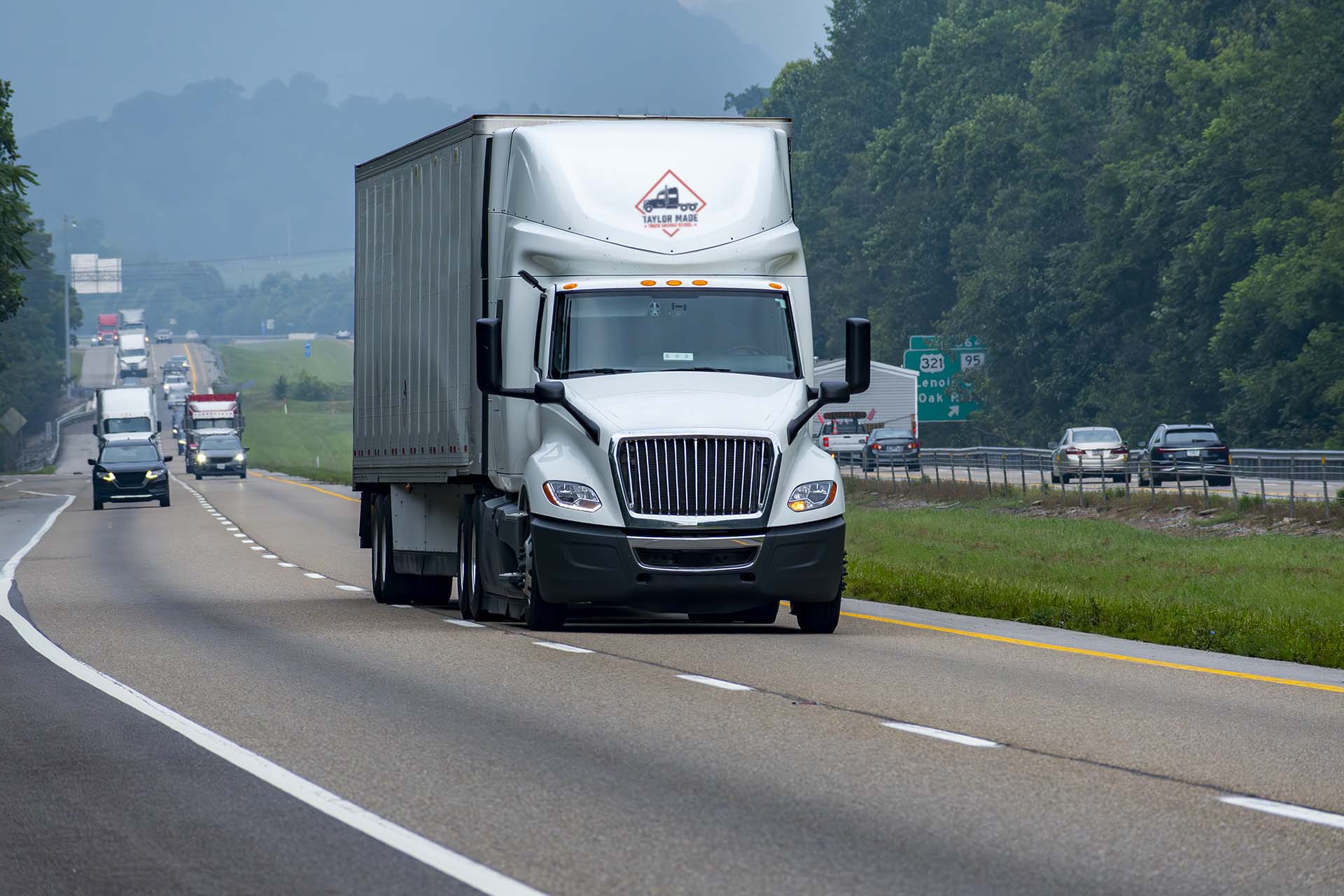
Training on real roads — Taylor Made TDS
Phase 2 — Range Work (Basic Vehicle Control)
Range work happens in a controlled area — no traffic, no pressure, just you, the truck, and your instructor. This is where you build the skills the examiner will evaluate on test day:
Straight-line backing — back the trailer in a straight line over a measured course
Offset backing — maneuver the trailer into an offset lane (left and right)
Alley docking — back the trailer into a marked dock space
Parallel parking — position the vehicle in a marked space on either side
Turns, stops, shifting — basic vehicle handling at speed
Range work takes repetition. Most students need meaningful practice before the moves become muscle memory. Our instructors are patient and specific — because bad habits developed in training show up on test day, and on every road day after that.
Phase 3 — On-Road Driving
Once range skills are solid, training moves to public roads. On-road instruction covers:
City Driving
Intersections, pedestrians, tight turns, narrow lanes
Highway Skills
Merging and lane changes with a loaded trailer
Railroad Crossings
Required stop — every time, no exceptions
Weather & Surface
Relevant in WA approximately ten months of the year
The Pre-Trip Inspection — Learn It Cold
The pre-trip inspection is evaluated on the skills test and required every single day you drive professionally. You must demonstrate that you can identify the vehicle's major components and flag any defects before the vehicle moves.
CDL Pre-Trip Inspection Points
Engine
Fluids, belts, hoses
Cab
Mirrors, gauges, steering
Lights
All functional
Tires/Wheels
Tread, pressure, lugs
Brakes
Air lines, chambers
Coupling
Fifth wheel, kingpin
Trailer
Doors, landing gear
Goal
No cheat sheet needed
At Taylor Made, every student learns the inspection sequence until they can walk it without a cheat sheet. That's what the examiner expects — and it's what keeps equipment failures from becoming accidents.
Ready for the road after skills testing
The CDL Skills Test — Three Components
Per current FMCSA and WA DOL requirements, the CDL skills test has three components:
Pre-Trip Vehicle Inspection
You verbally walk the examiner through the full inspection, identifying components and any defects.
Basic Vehicle Control (Range)
The examiner scores your backing and maneuvering exercises.
On-Road Driving
The examiner rides along and evaluates your performance on a predetermined route.
Scoring is based on errors — critical errors (automatic failure), serious errors, and scoring errors. You're demonstrating competence, not perfection.
Important: Taylor Made Truck Driving School does not administer CDL skills tests on-site. Skills testing is conducted by WA DOL or a DOL-authorized third-party tester only. Taylor Made coordinates scheduling assistance — the test itself is administered by a state-authorized examiner. This is required by law.
Our Outcomes
We take test prep seriously. Our students arrive at the skills test prepared — and it shows.
98%
Graduation Rate
96%
CDL Skills Test Pass Rate
July 2024–June 2025; Washington Workforce Training and Education Coordinating Board (WTB) and Taylor Made TDS internal records.
What Comes Next
Once you pass the skills test, WA DOL issues your CDL. You're a licensed commercial driver. See You Have Your CDL — Now What? for what the first job typically looks like. Or if you want to see the program itself first, check out our Class A Standard and Class A Professional Driver programs.
See Our Training Programs
Class A, Class B, endorsements, and refresher options available.